
Shaadi or the stock market? Find your dream partner (and millions) with this simple Valentine's Day checklist from Vatsal Ramaiya.

'We are not entirely out of the woods.' 'The broader trajectory remains tentative.' 'However, we may expect some near-term bounce.'

Investors have kept their eyes on US-China trade talks and are optimistic about a positive outcome.

Historically, March has been a volatile month for Indian equity markets. To begin with, it marks the end of a financial year, wherein there is some compulsive portfolio rebalancing trade by large funds - domestic and foreign. Retail investors, too, prefer to 'cash in' on their gains and losses before the financial year runs out.

Without exception, the top four majors beat Street estimates across all parameters - revenues, profitability, or net profit growth. However, what stood out were the large deal wins reported by the big two, TCS and Infosys.

Private lenders were among the top losers along with RIL.

'Markets are not expensive; they are fairly priced.'

Will 2022 be a year of contrasting narratives -- one filled with caution and the other with continued optimism?
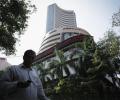
Side indices raced ahead with BSE Midcap and BSE Smallcap advancing 0.4% and 0.3% up, respectively.

Despite rising interest rates, and high inflation, the banking sector is doing well, on the back of a recovering economy. The last couple of quarters indicate credit demand is picking up and Return on Assets (RoA) is more than acceptable at the moment. The PSU bank pack may be more interesting at the moment simply due to being valued at far lower multiples than the private banks.

Markets finished the session on a dismal note with Sensex closing at its lowest level since August 2014.

Consumption-related stocks, such as hotels, and quick service restaurants (QSRs), have been hitting the ball out of the park ahead. On the other hand, the Miss World Pageant scheduled for later this year in New Delhi, too, could provide some tailwind to these stocks, especially hotels and aviation. However, analysts suggest investors put their best foot forward and buy these counters only on a decline given the recent rally and economic headwinds.

Among the Sensex firms, HCL Technologies fell the most by 2.4 per cent. IndusInd Bank (2.35 per cent), Infosys (2.28 per cent), Wipro (1.8 per cent), NTPC (1.71 per cent), Asian Paints (1.7 per cent), Tata Consultancy Services (1.36 per cent),Tech Mahindra (1.03 per cent) and SBI (1 per cent) were among the major laggards.

Finance Minister P Chidambaram has asked the Income Tax department to focus on the companies that pay less than effective tax rate of 24 per cent.

Swift gains on Dalal Street this year have also led to a sharp surge in shares of equity market intermediaries like depositories, exchanges, and registrar and transfer Agents (RTAs). The stock prices of BSE, CDSL, CAMS, and KFin Technologies are up 24-283 per cent so far in 2023 when compared to a 9 per cent rise in the benchmark Nifty index. With the market buoyancy expected to keep up the pace, analysts believe these stocks are a good long-term bet despite the sharp rally, which can trigger an intermittent correction.

Despite multiple headwinds at the start of 2023, the Indian markets delivered a strong performance, posting 19-20 per cent growth for the year. Even as new records were set, investor sentiment remains strong going into 2024, given the lower inflation, expectations of steady to lower interest rates, higher economic growth, and strong inflows. However, the overriding concern for most brokerages is valuations.
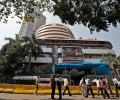
There were more than three losers against every gainer on BSE

The Nifty50 slipped 33 points to close the session at 8,509 after hitting an intra-day high of 8,587.

The market valuation of InterGlobe Aviation, the parent of IndiGo, reached Rs 1 lakh crore mark on Wednesday and became the first airline to achieve this milestone. On Wednesday, the stock rallied 3.55 per cent to settle at Rs 2,619.85 apiece on the BSE. In intra-day trade, shares of the company jumped 4.12 per cent to hit its 52-week high of Rs 2,634.25.

The initial public offering (IPO) market has seen some momentum of late with robust responses to recent issues. However, only some have been able to ride the wave. So far in 2023, 23 companies have let their approval granted by the markets regulator - the Securities and Exchange Board of India (Sebi) - lapse.

State-owned oil companies such as HPCL, BPCL, IOC, ONGC and OIL plunged on worries that the government may ask them to share the burden of higher petrol and diesel prices.

After pulling out $17 billion in calendar year 2022, foreign portfolio investors (FPIs) have pumped $7.3 billion back into equity markets so far this year. The turnaround in foreign flows has helped domestic markets exceed the all-time highs chalked up in December 2022 and bounced back more than 10 per cent from this year's lows. However, a big nugget of FPI inflows seen this year could be off the back of two factors: exchange-traded funds (ETFs) and block deals.

Sebi's surveillance department has red-flagged unusual trading patterns in some stocks. Shares of some companies were seen going up ahead of a sharp sell-off.
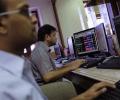
The broad market depicted strength. 1,525 shares rose and 1,131 shares fell. A total of 156 shares remained unchanged

From the Sensex pack, NTPC, Bajaj Finance, IndusInd Bank, UltraTech Cement, Bajaj Finserv, State Bank of India, Tata Motors, ITC, Power Grid and Larsen & Toubro were the biggest gainers. IndusInd Bank climbed 2 per cent after the company on Tuesday reported a 30 per cent jump in consolidated net profit in April-June quarter at Rs 2,124.50 crore, helped by core income growth and lower bad loan provisions.

The Street shrugged off a muted first quarter of financial year 2023-24 (Q1FY24) and a cautious near-term outlook by India's largest information technology (IT) services company, Tata Consultancy Services (TCS). The stock was the top Nifty50 and Sensex gainer on Thursday, rising 2.5 per cent, as investors took comfort from a robust order book and an encouraging pipeline. Like its larger peer, HCL Technologies' (HCL Tech), too fell short of the Street's expectations on the revenue and margin fronts given cuts in discretionary expenditure.

The BSE is planning to reintroduce its Sensex-30 derivatives and is in the process of collecting feedback from members, the MD and CEO of the premier bourse, Sundararaman Ramamurthy, said on Friday. The Sensex-30 derivatives products (options and futures), which were launched in 2000, had failed to generate much interest among investors compared to the rival exchange's Nifty-50 derivatives. "We are trying to reintroduce Sensex-30 derivatives, and have started the consultation process by taking the feedback of market participants," Ramamurthy said at an Assocham-organised event in Kolkata.

Investors seem to be shying away from stocks of companies in the 'digital' space with most counters that comprise the Nifty India Digital index giving negative returns over the past year. The index tracks the performance of a portfolio of stocks that broadly represent the 'digital theme' within basic industries, such as software, e-commerce, IT-enabled services, industrial electronics, and telecom services. The fall in some of these stocks over the past year has been steep; the sharpest decline of around 60 per cent was seen in shares of PB Fintech (parent company of Policybazaar).

Yes Bank was the biggest loser in the Sensex pack in absolute terms, cracking 12.85 per cent, after the company reported a massive 92.44 per cent slump in consolidated net profit to Rs 95.56 crore. ONGC, Tata Motors, M&M, Maruti, Vedanta, Bajaj Auto, TCS, SBI and HCL Tech lost up to 4.24 per cent.

The improvement in the performance of actively managed mutual fund (MF) schemes is acting as a key tailwind for the nearly Rs 50 trillion industry, Kotak Institutional Equities (KIE) said in a report. The report adds that the two largest listed asset management companies (AMCs) - HDFC and Nippon India - are likely to be the biggest beneficiaries. "The industry has a solid track record of delivering alpha on 10-year returns (70-80 per cent of assets under management (AUM) beat the benchmark), with shorter duration performance also on an upswing.
Dwaipayan Bose highlights the similarities and contrasts between ETFs and Index Funds.

In a memorable year for the equity market, Dalal Street investors added a whopping Rs 81.90 lakh crore to their wealth in 2023 as a raft of positive factors powered a stellar rally in stocks. Experts said India's strong macroeconomic fundamentals, political stability owing to the BJP's success in recent elections in three significant states, optimistic corporate earnings outlook, signals from the US Federal Reserve about three prospective rate cuts next year and heavy retail investors participation played a major role in fuelling the stock market rally in 2023. In the year 2023, the 30-share BSE Sensex jumped 11,399.52 points or 18.73 per cent.

Buying and selling of exchange trade fund (ETF) units worth less than Rs 25 crore will now have to take place compulsorily on the stock exchange platform, according to a new rule which comes into effect on Tuesday. The fresh norm, which comes into being after two deferments, is aimed at boosting liquidity and reducing tracking error. At present, investors directly deal with the asset management companies (AMCs) for purchase and redemption of ETFs - passive schemes that track a particular benchmark such as the Nifty50 index.

'We are cautious only on sub-sectors that have seen massive melt-up during the past six months.'

'Investors with higher risk appetite and longer horizon (more than one year) can invest in longer-duration funds like corporate bond funds, long-duration funds and gilt funds for maximum gain.'

Nifty50 surged 87 points to end at 8,157, highest closing levels since Oct 29, 2015.

The BSE Midcap also cut all its intraday gains to shed 0.3% at close

The most consistent wealth creators since 2008 are all consumer-facing companies, says Devangshu Datta.

TCS, Bajaj Auto, Adani Ports and Cipla were the top gainers on BSE Sensex while Coal India, GAIL, Dr Reddy's and Infosys lost the most on the index.

The 55 basis point (bps) spike in the US 10-year bond yield, triggered by a combination of FOMC's hawkish commentary and BOJ's relaxation of the yield control curve (YCC) has made analysts cautious on Asian equities and expect them to trade sideways in the short-to-medium term.
 © 2026 Rediff.com - Advertise with us - Disclaimer - Privacy Policy - Sitemap - Feedback - About us - Terms of use - Grievances